Book a Free Demo Class
Generative Engine Optimization (GEO): Win AI Search 2026
You did everything right. You published consistently, earned backlinks, fixed your Core Web Vitals, and watched your keyword rankings hold steady. But somewhere in the last twelve months, your organic traffic started quietly bleeding out — and no ranking report could explain why.
Here’s what’s actually happening.
Millions of searches that used to land on your website are now being answered directly inside ChatGPT, Google AI Overviews, Perplexity, and Claude. Users are getting full, confident responses from AI — and never clicking a single link. Your rankings didn’t drop. Your visibility did.
This is the silent traffic crisis of 2026, and traditional SEO alone cannot fix it.
The solution is Generative Engine Optimization (GEO) — the practice of structuring your content, authority signals, and technical setup so that AI search engines don’t just crawl your site, they cite it. While SEO gets you ranked, GEO gets you recommended. And in a world where AI is answering 40% of all searches, being recommended is worth more than being ranked.
This guide is your complete, step-by-step playbook. Whether you’re an SEO professional, a brand marketer, or a business owner trying to stay visible in an AI-first world — by the end of this article, you’ll know exactly what GEO is, why it matters, and how to implement it starting today.
What Is Generative Engine Optimization?
Generative Engine Optimization (GEO) is the process of optimizing your content, brand authority, and technical setup so that AI-powered search engines - like ChatGPT, Google AI Overviews, and Perplexity - cite your website as a trusted source inside their generated answers. Unlike traditional SEO, which earns you a ranked link, GEO earns you a direct citation in the AI's response - placing your brand in front of the user before they ever scroll to a results page.
Think of it this way. Traditional search was like competing to be the loudest voice in a crowded library - the one who shouted the right keywords got noticed. Generative AI search is different. Now, a single intelligent assistant reads every book in that library, synthesizes the best answer, and decides whose work is worth quoting. GEO is how you become the source that assistant quotes.
SEO vs. AEO vs. GEO - What is the Difference?
All three approaches serve a different layer of modern search. Understanding where each one fits helps you build a strategy that covers every surface where users look for answers.
| Approach | Full Form | Goal | Where It Works | What You Optimize For |
|---|---|---|---|---|
| SEO | Search Engine Optimization | Rank on Page 1 of Google | Traditional SERP blue links | Keywords, backlinks, technical health |
| AEO | Answer Engine Optimization | Win featured snippets and direct answers | Google Featured Snippets, Voice Search | Q&A structure, schema, concise answers |
| GEO | Generative Engine Optimization | Get cited inside AI-generated responses | ChatGPT, AI Overviews, Perplexity, Claude | Entity authority, original content, brand signals |
A user opens Perplexity and asks: "What is the best on-page SEO strategy for 2026?" - Perplexity does not return ten links. It generates a structured answer and cites 3-4 websites as its sources. If your website is one of those citations, you get qualified traffic, brand visibility, and authority - without the user needing to search further. That is GEO working for you.
Which Platforms Does GEO Target?
Generative AI search is no longer limited to one platform. Your content needs to be optimized for citation across all major AI-powered search engines that users rely on daily.
OpenAI's search mode cites live web sources in conversational answers
Google's generative summary shown above traditional results
Answer-first search engine with inline citations from the web
Anthropic's AI assistant increasingly used for research queries
Bing-powered AI integrated into Windows and Microsoft 365
Why GEO Matters More Than Ever in 2026
The shift happening right now is not a minor algorithm update you can fix with a few meta tags. It is a structural change in how people find information - and how brands get discovered. If your AI search optimization strategy is not in place yet, you are already behind the brands that started six months ago.
of all searches projected to happen via generative AI by end of 2026 - McKinsey
faster growth in AI-referred traffic compared to traditional organic traffic in 2025-2026
of Google searches in 2026 now end without a click, up from 49% in 2023
McKinsey projects that by 2026, over 40% of all search interactions will take place through generative AI interfaces. That means nearly half your potential audience may never see a traditional search result - they will ask an AI, get an answer, and move on. If your brand is not cited in that answer, you simply do not exist for that user.
What Google's Own Guidance Says (May 2026)
Google published updated developer guidance in May 2026 making one thing very clear - the best way to appear in AI-generated features is to focus on foundational content quality, not manipulation tactics. Google advises that AI systems favor content that demonstrates first-hand experience, original insight, and genuine expertise that cannot be replicated by a generic AI model. Websites that publish unique data, real case studies, and expert-led articles are being cited more frequently than those relying on rehashed, keyword-stuffed pages.
Google's AI generative features use publicly accessible, crawlable content. Blocking AI crawlers like GPTBot or PerplexityBot in your robots.txt file - even accidentally - means your site cannot be cited in AI answers, regardless of how strong your traditional SEO is.
The "Cited Not Ranked" Mindset Shift
The most important mental shift for any SEO professional in 2026 is moving from chasing ranking positions to earning AI citations. These are two very different goals that require two very different strategies.
"I need to rank #1 on Google for this keyword."
"I need AI to cite my brand as the best answer to this question."
Ranking gets you a click from someone who is already browsing results. Being cited places your brand inside the answer itself - where the user's trust and attention are highest. A single AI citation in ChatGPT or Google AI Overviews can drive more qualified traffic than a page-3 ranking ever will. That is the core value proposition of a strong GEO strategy 2026 built around authority, structure, and original content.
How GEO and SEO Work Together
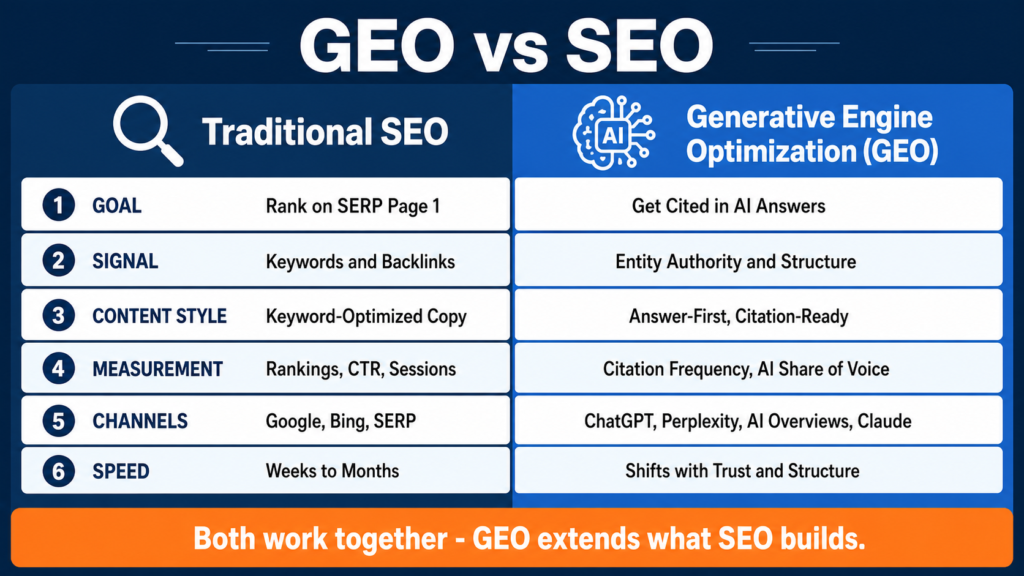
Traditional SEO helps your pages get discovered, crawled, indexed, and ranked. Generative Engine Optimization helps AI systems understand your content, trust your brand, and cite your pages when users ask deeper or more conversational questions.
In practical terms, SEO brings your content into the search ecosystem, while GEO improves your chances of being surfaced inside AI-driven answers across ChatGPT, Google AI Overviews, Perplexity, Claude, and Copilot.
If you want more leads, more traffic, and better brand recall, you need both. Strong technical SEO gives your content a solid foundation, and a smart GEO strategy 2026 approach helps that same content earn visibility in AI search optimization environments where click behavior is changing fast.
Google Search still plays a central role in discovery, but winning modern visibility now means being easy to crawl, easy to verify, and easy to cite.
GEO vs. Traditional SEO - Key Differences
SEO and GEO support each other, but they are not the same thing. SEO focuses on ranking pages in search results, while Generative Engine Optimization focuses on making your content useful enough, clear enough, and authoritative enough to be selected inside AI-generated answers.
| Factor | Traditional SEO | GEO |
|---|---|---|
| Goal | Rank pages higher in search results and attract clicks. | Earn citations, mentions, and visibility inside AI responses. |
| Signal | Keywords, links, crawlability, page experience, and relevance. | Entity clarity, trust signals, structure, source quality, and citation-worthiness. |
| Content Style | Search-optimized copy built around topics and intent. | Answer-first copy with definitions, examples, lists, tables, and original insight. |
| Measurement | Rankings, impressions, CTR, sessions, and conversions. | AI citation frequency, share of voice, branded mentions, and AI-referred visits. |
| Channels | Google Search, Bing, and standard SERPs. | ChatGPT, Google AI Overviews, Perplexity, Claude, Copilot, and hybrid search surfaces. |
| Speed | Often slower and tied to crawl cycles, competition, and authority growth. | Can shift quickly when your content becomes more structured, trusted, and easy to quote. |
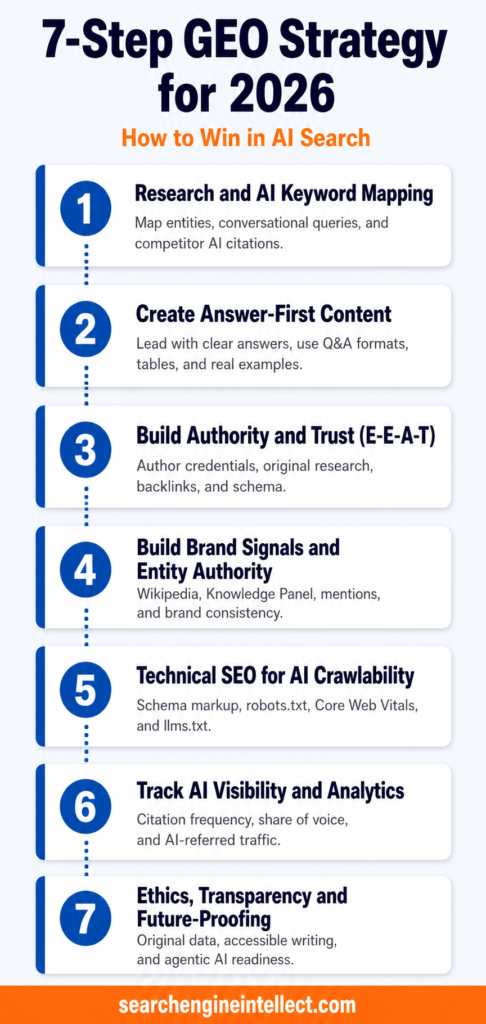
The 7-Step GEO Strategy for 2026
If your goal is to rank in AI Overviews, increase organic visibility, and build authority that survives future algorithm changes, this is the section that matters most. Each step strengthens the connection between your site, your expertise, and the topics you want search engines and AI assistants to associate with your brand.
Step 1 - Research and AI Keyword Mapping
Start with the language real people use when they search or prompt an AI assistant. Instead of chasing only short commercial phrases, build pages around conversational questions and entity relationships.
- Target conversational queries like how, what, why, and best.
- Map entities tied to your brand, including people, products, services, tools, and locations.
- Cluster intent into informational, transactional, and prompt-driven journeys.
- Audit competitor citations inside AI answers to see which pages, formats, and claims are being referenced most often.
This is where strong AI search optimization begins. If the prompt language is missing from your site, your chances of being cited are much lower.
Step 2 - Create Answer-First, Citation-Worthy Content
Lead with the answer, not the buildup. AI systems prefer pages that state the topic clearly, define it quickly, and support that definition with useful structure.
- Open each section with a direct answer in the first two or three sentences.
- Use Q&A and FAQ formatting where it helps the reader.
- Add stats, case studies, original observations, and practical examples.
- Break up information with lists, tables, checklists, and short paragraphs.
- Keep the voice natural, specific, and human. Avoid padded copy and repetitive phrasing.
A good GEO strategy 2026 page does not sound robotic. It sounds like an expert explaining something clearly to a smart reader.
Step 3 - Build Authority and Trust Signals
Authority matters because AI systems are more likely to surface content that appears reliable, original, and attributable. Readers also trust pages more when expertise is visible instead of implied.
- Add author bios with real credentials, experience, and topic relevance.
- Publish original research, mini studies, screenshots, audits, or real campaign learnings.
- Earn backlinks from respected and relevant sites instead of chasing volume.
- Use reviews and testimonials where they genuinely support the page.
- Implement Product, FAQ, and Review schema where appropriate.
For context on experience, expertise, authoritativeness, and trust, link to Google's E-E-A-T guidance and support this section with your own expert examples.
Step 4 - Build Brand Signals and Entity Authority
AI systems do not evaluate pages in isolation. They also connect your brand to topics, mentions, references, and consistency across the wider web.
- Create or improve your Wikipedia or Wikidata presence if your brand qualifies.
- Strengthen your Google Knowledge Panel with accurate public information.
- Earn mentions in forums, industry roundups, podcasts, and digital PR placements.
- Keep your brand description, services, authors, and niche language consistent across every platform.
You can explain the authority concept further with a contextual link to PageRank, then connect that idea to modern entity authority and brand recognition.
Step 5 - Technical SEO for AI Crawlability
Even the best content underperforms if bots cannot access it, interpret it, or connect it to the rest of your site. Technical SEO remains the base layer that supports both classic rankings and Generative Engine Optimization.
- Implement schema markup such as FAQ, HowTo, Article, and Organization.
- Check your robots.txt file so important bots are not blocked unnecessarily.
- Use topic clusters and internal linking to show content relationships clearly.
- Improve Core Web Vitals, mobile usability, and page speed.
- Add an llms.txt file if it supports your AI content discovery strategy.
- Show a visible Last Updated date on important evergreen pages.
2026 Spam Warning: Do not scale pages just to manipulate rankings. Avoid thin copy, scraped content, keyword stuffing, doorway pages, and link schemes. Build pages that genuinely help the reader and add original value.
Step 6 - Track AI Visibility and Analytics
What you cannot measure, you cannot improve. GEO needs its own reporting layer so you can see whether your content is being cited, summarized, or ignored.
| Metric | What It Shows | Suggested Tools |
|---|---|---|
| Citation Frequency | How often AI systems mention or quote your brand. | Peec, Profound, manual audits |
| Share of Voice | Your visibility versus competitors across AI answers. | Semrush AIO, Peec |
| Citation Sentiment | Whether the brand mention is accurate, neutral, or favorable. | Manual review, brand monitoring |
| AI-Referred Traffic | Sessions and conversions coming from AI surfaces. | GA4, server logs, attribution tools |
| SERP + AI Overlap | Where you rank traditionally and where you appear in AI answers. | Semrush AIO, content audits |
When you review this data consistently, you can see which pages help you rank in AI Overviews and which pages need stronger structure, authority, or clearer messaging.
Step 7 - Ethics, Transparency and Future-Proofing
The safest long-term path is to publish content that is transparent, useful, and easy to verify. This protects your rankings, strengthens trust, and makes your site more resilient as AI search evolves.
- Add clear source attributions, citations, and reasonable disclaimers where needed.
- Use accessible and inclusive writing that real people can understand quickly.
- Publish proprietary data, original observations, or internal benchmarks when possible.
- Test voice search style content and hybrid formats like article plus video plus transcript.
- Prepare for agentic AI experiences where assistants compare, summarize, and act across multiple sources.
Link this section to Google Spam Policies so readers understand that sustainable growth comes from helpful content, not shortcuts.
Common GEO Mistakes to Avoid
Many brands publish content for AI search optimization but still fail to earn visibility because the page is not easy for large language models to trust, interpret, or cite. If your Generative Engine Optimization strategy is not producing results, one of these common mistakes is usually the reason.
Blocking AI crawlers by accident
A strong GEO strategy 2026 starts with access. If your robots.txt blocks GPTBot, ClaudeBot, or other AI crawlers, your content may never be discovered for AI search optimization or cited in answer engines.
Publishing generic content with no original value
Generic summaries rarely help you rank in AI Overviews because they sound like everything else already online. Add real examples, original insights, practical observations, and clear expert commentary that make the page worth citing.
Ignoring schema and page structure
When a page has no FAQ, Article, Organization, or HowTo schema, AI systems get less context about the content. Clean headings, lists, tables, and structured data make Generative Engine Optimization much easier to execute.
Mass-producing thin AI content
Publishing dozens of shallow pages may increase index count, but it usually weakens trust. Thin, repetitive, low-effort articles damage LLM SEO checklist readiness because they do not show expertise, authority, or a clear reason to cite your site.
Weak internal linking and topic clustering
Pages that sit alone are harder for search engines and AI systems to understand. Connect related articles through smart internal links so your site builds stronger topical authority around AI search optimization and related search intent.
Tracking rankings but not AI visibility
Traditional rankings still matter, but they do not show the full picture. If you are not monitoring brand mentions, citation frequency, and visibility across AI platforms, your GEO strategy 2026 is operating without real performance feedback.
GEO Quick-Start Checklist (30-Day Plan)
If you want a practical starting point, use this 30-day plan to build a stronger foundation for Generative Engine Optimization. Each week focuses on one area that improves AI search optimization, trust signals, and your chance to rank in AI Overviews.
Week 1 - Audit
- Review your top pages and identify which ones already bring search traffic, backlinks, and conversions.
- Check robots.txt, crawl settings, and indexation issues that may block AI crawlers or reduce page visibility.
- Search your target topics in ChatGPT, Perplexity, and Google AI Overviews to see which competitors get cited most often.
Week 2 - Content
- Rewrite your top priority article with answer-first paragraphs, clean subheadings, and stronger context around the primary keyword.
- Add lists, tables, FAQs, and short examples that make the page easier to scan, summarize, and cite.
- Improve weak sections with unique insights so the content supports both GEO strategy 2026 and traditional search intent.
Week 3 - Authority
- Add author bios, credentials, company details, and trust signals that support expertise and brand authority.
- Strengthen internal links between related articles so your content works like a topic cluster instead of isolated posts.
- Look for opportunities to earn mentions, links, reviews, and references from relevant websites in your niche.
Week 4 - Measure
- Track impressions, clicks, and engagement changes after content updates across key landing pages.
- Monitor whether your brand appears more often in AI answers for core informational and commercial queries.
- Build a simple reporting sheet for citations, organic traffic, assisted conversions, and pages most likely to rank in AI Overviews.
Frequently Asked Questions
These FAQs answer the most common questions people ask about Generative Engine Optimization, AI search optimization, and how brands can improve visibility across modern search experiences.
Generative Engine Optimization is the process of improving your content so AI-powered search systems can understand it, trust it, and cite it in generated answers. It focuses on clear structure, strong authority signals, useful information, and content written for real users rather than just keyword placement.
Traditional SEO focuses heavily on rankings, clicks, and position in search results. GEO adds another layer by helping your pages appear inside AI-generated responses, summaries, recommendations, and citations across search platforms.
AI-driven search experiences are changing how users discover information. More people now get answers directly from search assistants, which means brands need content that is easy to extract, verify, and cite if they want to stay visible.
Yes, GEO can improve your ability to rank in AI Overviews by making your pages more useful, structured, and trustworthy. While no method guarantees placement, strong answers, clean formatting, clear entities, and authority signals improve your chances.
Content that performs best usually answers specific questions clearly, includes first-hand insight, uses helpful formatting, and covers the topic in depth without sounding repetitive. Practical guides, comparison pages, definitions, case studies, and expert explainers often work well.
Schema markup helps search engines and AI systems understand what your page is about. It does not guarantee citations by itself, but it improves clarity around your content, organization, FAQ sections, reviews, and article details.
AI can support research, drafting, and content planning, but the final article should still reflect human judgment, experience, and editing. The strongest GEO pages feel natural, provide original value, and avoid the flat tone of mass-produced content.
The biggest mistakes include blocking AI crawlers, publishing generic articles, ignoring schema, creating thin AI content at scale, and failing to measure AI visibility. Many sites also miss opportunities because they do not connect related content through strong internal links.
Results depend on your site authority, content quality, competition, and crawl frequency. Some improvements can help quickly, but in most cases a GEO strategy 2026 approach works best when treated as an ongoing content and authority-building process.
Your main keyword should be Generative Engine Optimization. You can naturally support it with related phrases like GEO strategy 2026, AI search optimization, rank in AI Overviews, and LLM SEO checklist where they fit the topic and user intent.