Table of Contents
Book a Free Demo Class
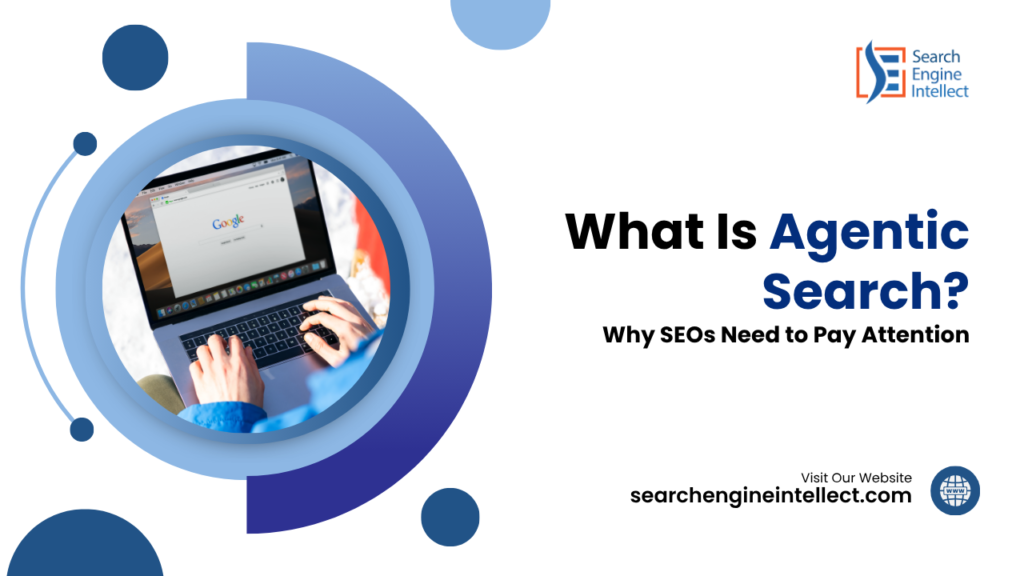
What Is Agentic Search? (And Why SEOs Need to Pay Attention)
Search -used to be simple.
You typed a query. Google showed you ten blue links. You clicked. You read. You found your answer.
But in 2026, that’s no longer how search works – and if you’re an SEO professional, a business owner, or a digital marketer, this change affects everything you thought you knew about getting found online.
Welcome to the era of agentic search.
Today, when someone asks Google “find me the best digital marketing agency in my city, check their reviews, compare their pricing, and book a free consultation” – Google doesn’t show them links. It does it for them. Automatically. Autonomously. In seconds.
That’s not science fiction. That’s what Google announced at Google I/O 2026 in May – a new AI Mode where search agents plan, research, compare, and complete multi-step tasks on your behalf, without you ever visiting a single website.
For users? It’s incredibly convenient.
For SEOs? It’s the biggest disruption since the Penguin update.
Here’s the uncomfortable truth most SEO blogs won’t say out loud: your current SEO strategy was built for a world that no longer exists. Ranking #1 for a keyword means far less when an AI agent never shows that keyword result to the user in the first place.
But here’s the good news – this isn’t the end of SEO. It’s the evolution of it.
The brands that understand how agentic search works, how AI agents choose their sources, and how to structure content for LLM visibility will dominate search results in 2026 and beyond. The ones that ignore it will slowly disappear from the digital map.
What Is Agentic Search?
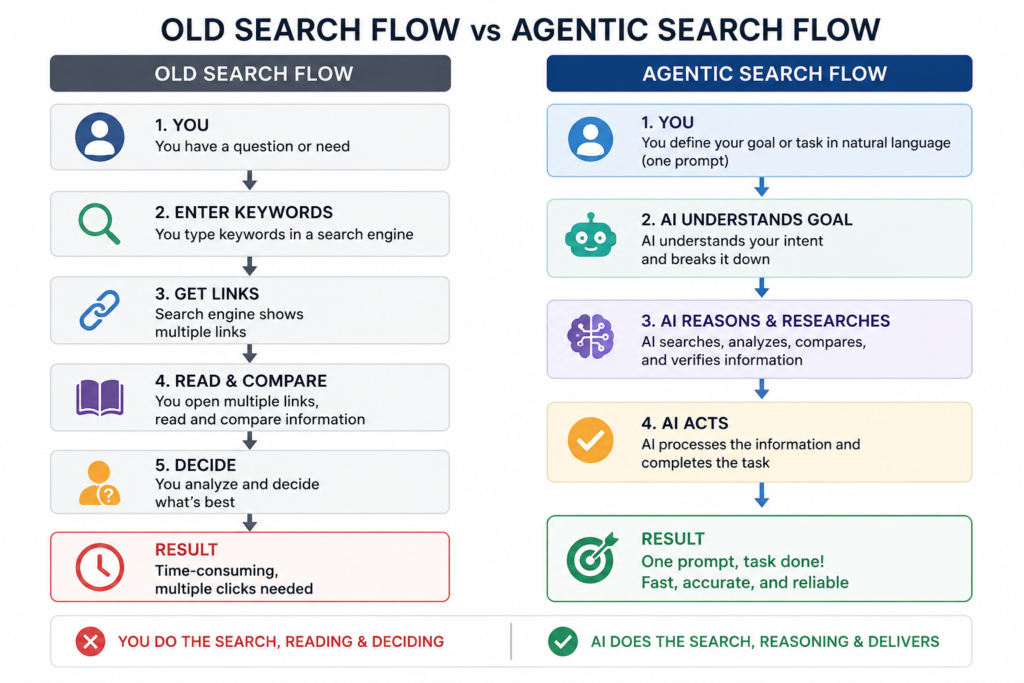
Agentic search is a new generation of AI-powered search that doesn’t just find information – it takes action on your behalf. Instead of returning a list of links for you to click through, an agentic search engine understands your goal, breaks it into steps, and completes the task for you – all within a single prompt.
Think of it this way. Traditional search works like a librarian – you ask for a topic, they point you to the right shelf, and the rest is up to you. Agentic search works more like a highly capable personal assistant. You say, “Find me the best digital marketing agency in Bareilly, check their reviews, and draft me an enquiry email” – and it does exactly that, start to finish, without you lifting a finger.
This shift is already happening across the world’s biggest search platforms. Google launched its AI Mode at Google I/O 2026, allowing users to complete multi-step tasks directly inside Search. ChatGPT Search (by OpenAI) can browse the web, compare options, and deliver direct answers in conversation. Perplexity AI functions as a real-time research assistant, citing sources as it answers. Claude (by Anthropic) handles complex reasoning tasks and document analysis alongside search. Each of these platforms is moving in the same direction – from finding to doing.
At the core of every agentic search engine are Large Language Models (LLMs) – advanced AI systems trained on vast amounts of text that can understand intent, reason through problems, and generate human-quality responses. Without LLMs, agentic search as we know it today would not exist.
Also read: Voice Search Optimization Guide 2026: Boost Your Rankings
Inside the Process How Does Agentic Search Work?
When you type a goal into an agentic search engine, the system does not simply look up a matching webpage. It follows a structured, multi-step process - almost like a trained analyst working through a brief. Here is exactly what happens from the moment you hit Enter to the moment you receive a response.
The AI does not treat your input as a set of keywords. It reads the full context of your goal - who you are, what you actually need, and the outcome you are working toward. This is called intent parsing, and it is what separates agentic search from a traditional keyword lookup. A query like "best project management tool for a 5-person remote team under $20 a month" is understood in full, not broken into fragments.
Once it understands your intent, the system builds a plan. It breaks your goal into a logical series of sub-tasks - for example, fetching review data, comparing pricing pages, and cross-checking user ratings. This planning stage is what makes agentic search genuinely different from an AI chatbot. Rather than guessing at a single answer, it thinks in steps.
This is where it gets interesting. The agent begins executing each sub-task on its own - browsing live web pages, pulling structured data, running comparisons, and reading content from multiple sources simultaneously. It interacts with the web much like a human researcher would, except at machine speed. Your website is either read during this phase, or it is skipped entirely - and that choice comes down to your AI search optimization signals.
The final output is not a list of ten blue links. It is a direct, synthesized response that completes the user's original goal. Sources may be cited, but the user rarely needs to click through. For SEOs, this is the most important stage to understand - because if your content was used, it should appear as a citation. If it was not, your brand essentially did not exist for that search.
Google AI Mode (Launched May 2026): At Google I/O 2026, Google officially launched AI Mode - a dedicated search experience where users can give complex, multi-step goals directly to Google's agents. This is not a feature layered on top of traditional search. It is a fundamentally different interface. It is already integrated with Google Workspace (Docs, Gmail, Calendar), Google Maps (local business lookup, route planning), and Google Shopping (product comparisons, price tracking, cart management). Your digital presence across all these surfaces now directly affects your LLM SEO 2026 visibility.
Side-by-Side Breakdown Agentic Search vs. Traditional Search vs. AI Overviews
A lot of SEOs use these three terms interchangeably, but they describe very different systems with very different implications for your content strategy. Understanding how they differ is the first step to building a search strategy that works in 2026. The table below breaks down what each system does, what triggers it, and what your SEO goal should be for each.
Traditional search engine optimization was built around one core idea - rank your page as high as possible for a given keyword. That logic still applies to the blue-link results, but two newer surfaces, AI Overviews and agentic search, each require a different approach entirely.
| Feature | Traditional Search | AI Overviews | Agentic Search 2026 |
|---|---|---|---|
| What it does | Returns a ranked list of links | Summarizes an answer using multiple pages | Completes the user's task from start to finish |
| User action | Click, read, and research independently | Skim the summary, sometimes click for more | Minimal - the AI acts on the user's behalf |
| Data sources | Indexed URLs matched by keyword | Multiple crawled web pages per query | Web + APIs + external tools + live data |
| SEO goal | Rank #1 for target keyword | Earn Position 0 + AI citations | Build entity authority + be a trusted source |
| Trigger type | Short keyword query | Informational or question-based query | Goal-based or multi-step task prompt |
| Click-through | High - users visit pages | Reduced - answer shown upfront | Very low - agent handles the journey |
| Ranking factor | Backlinks, on-page optimization | Structured content, E-E-A-T signals | Trust signals, schema, entity recognition, freshness |
| Content format | Long-form keyword-optimized pages | FAQ sections, concise definitions | Answer-first content, structured data, unique insights |
The key takeaway from this comparison is that all three surfaces can and do appear on the same results page. Your AI search optimization strategy should address all three simultaneously - not treat them as separate workstreams. A page optimized only for traditional ranking will underperform in AI Overviews, and a page with no schema markup will be consistently overlooked by agentic search agents, regardless of how well it ranks in standard results.
Also read: SEO, AIO, GEO, AEO, SXO: What's the Real Difference?
Why SEOs Need to Pay Attention Right Now
Most SEOs know that AI is changing search. Fewer realize just how fast that change is happening - and how much ground they are already losing. The data from early 2026 tells a clear story: brands that have adapted to agentic search are holding their traffic, while those still running a purely traditional SEO playbook are watching their click numbers fall month after month.
The winners in agentic search are not the ones with the most backlinks - they are the ones AI agents trust enough to cite.
Search Engine Intellect — LLM SEO Analysis, May 2026
A benchmark report from SEOTesting recorded a significant and sustained decline in organic clicks across retail and e-commerce sites - directly tied to Google expanding AI Mode. Users are still searching. They are just not clicking through to websites anymore.
Users are getting answers without visiting your site
When an AI agent completes a task - comparing products, summarizing a guide, or booking a service - it rarely sends the user to an external page. Your content is being read and used, but that traffic is not showing up in your analytics. Optimizing only for clicks is now an incomplete AI search optimization strategy.
AI agents choose sources on trust, not rankings alone
Backlinks still matter, but they are no longer the dominant signal in an agentic environment. AI systems evaluate content clarity, factual accuracy, author credibility, schema structure, and entity consistency across the web. A mid-sized site with strong E-E-A-T signals regularly outperforms high-DR domains that lack structured, trustworthy content.
Google's new crawler interacts with your site like a real user
Google's AgentSpace crawler - confirmed in early 2026 - no longer just reads static HTML. It navigates menus, interacts with page elements, and evaluates user experience quality. Your site architecture, navigation, and page-level UX now directly influence how well your content is cited in agentic search results.
Optimizing for AI models is now equally important as traditional SEO
ChatGPT Search, Perplexity, Claude, and Gemini collectively handle hundreds of millions of queries per day. If your brand is invisible in these AI-powered answer engines, you are missing a growing audience segment - one that traditional Google rank tracking will never capture.
What has actually changed for SEOs in 2026
- Ranking #1 is no longer enough. If the AI Overview answers the query completely, your top result may receive no clicks at all.
- Backlink profiles are necessary but not sufficient. AI agents weigh structured content, author authority, and schema alongside link equity.
- Content must be answer-ready, not just keyword-dense. Agentic systems extract specific answers - loose, unstructured prose gets passed over.
- Brand entity consistency has become a core ranking factor. Your name, niche, and expertise must appear consistently across Wikipedia, news, forums, and your own site.
- AI visibility tracking is now a separate discipline. Your citation rate in ChatGPT, Perplexity, and Gemini needs its own measurement strategy alongside traditional SEO reporting.
- The May 2026 Google spam update targets low-quality AI-generated content. Articles that read like templates are being excluded from AI Overviews entirely.
| SEO Factor | Traditional Impact | Agentic Search Impact | Priority |
|---|---|---|---|
| Keyword Rankings | Primary traffic driver | Still relevant but click value is declining | Medium |
| Backlink Profile | Strongest ranking signal | Necessary but not sufficient for AI citation | Medium |
| E-E-A-T Signals | Quality guideline | Primary AI trust and citation signal | Critical |
| Schema Markup | Rich snippet enhancer | Core requirement for AI content parsing | Critical |
| Content Freshness | Moderate signal | High — AI agents prefer recently updated pages | High |
| Page Experience / UX | Core Web Vitals factor | AgentSpace crawler evaluates navigation quality | High |
| Brand Entity Authority | Indirect signal via mentions | Direct factor in AI confidence and citation rate | Critical |
Also read: Gemini vs. ChatGPT: Which is Better AI Tool in 2025?
The 7-Pillar LLM SEO Framework for Agentic Search
If you want to win in Agentic Search, you need more than basic on-page SEO. You need a system that helps AI platforms understand your brand, trust your content, and choose your pages when they build direct answers for users.
This framework is built for modern LLM SEO 2026, where success depends on strong entity signals, useful structure, real expertise, and content that genuinely helps people. It also aligns with current quality expectations around original value, human oversight, and avoiding scaled low-value pages that look manufactured for rankings.
1. Research & Keywords — Get Found in AI
Traditional keyword research still matters, but it is no longer enough on its own. In agentic environments, users ask longer, more natural questions, so your research process should focus on conversational queries and topic depth instead of isolated phrases.
Start by mapping the entities around your topic. That includes brands, tools, people, platforms, products, and related concepts that help search engines and AI systems understand the full context of your content.
- Build content around conversational searches such as what, why, how, best, and vs.
- Map topic entities clearly so your page connects with real-world meaning, not just keywords.
- Cluster search intent into informational, commercial, navigational, and prompt-driven journeys.
- Review competitor citations inside Google AI results, Perplexity, ChatGPT Search, and other answer engines.
2. Content & Answers — Feed AI the Right Info
AI systems prefer pages that answer the main question quickly, clearly, and in plain language. That means every important section should open with a direct answer before moving into supporting details, examples, or nuance.
Strong AI Search Optimization also depends on structure. Use short paragraphs, FAQ blocks, data points, tables, checklists, and examples that make your content easy to scan, extract, and cite.
- Open each section with an answer-first paragraph.
- Use FAQ formatting for questions people actually ask.
- Add stats, case studies, screenshots, examples, or original observations where possible.
- Use lists and tables to make complex ideas easier to understand and easier for AI to parse.
- Include unique insights so your content does not read like a rewritten summary of competing pages.
3. Authority & Trust — Make AI Choose You
In an AI-first search environment, trust is a ranking signal and a selection signal. If an LLM is deciding which sources to reference, it will favor pages that show expertise, editorial care, and evidence of real-world credibility.
Add visible author details, show who reviewed the content, and support claims with original research, expert commentary, strong references, and relevant social proof. This is where quality frameworks such as E-E-A-T become practical, not theoretical.
- Add author bios with experience, credentials, and topic specialization.
- Publish original studies, survey data, audits, or tested examples whenever possible.
- Earn backlinks from trusted and contextually relevant websites.
- Show reviews, testimonials, case results, and proof of work.
- Implement schema markup so machines can interpret your credibility signals more accurately.
4. Brand Signals — Build Entity Authority
Strong brands tend to appear more often in AI-generated answers because they are easier to verify across the web. Your goal is to create consistent entity signals that connect your business name with the topics you want to own.
This includes structured brand mentions, profile consistency, and third-party references across reliable sources. When your name appears repeatedly in relevant contexts, AI systems gain more confidence in your authority.
- Create or improve your brand presence on platforms such as Wikipedia or Wikidata when appropriate.
- Strengthen your Google Business Profile and work toward a clear Knowledge Panel footprint.
- Earn mentions in niche communities, podcasts, interviews, expert roundups, and industry publications.
- Keep your brand consistently linked with your priority topics across your site and external sources.
5. Technical SEO — Make AI Understand You
Great content can still underperform if your site structure is messy, slow, or difficult to interpret. Technical SEO gives both search engines and AI agents the signals they need to crawl, understand, and trust your content at scale.
| Technical Factor | Why It Matters for Agentic Search |
|---|---|
| Schema Markup | Helps AI agents parse entities, questions, products, services, reviews, and page meaning with greater accuracy. |
| Topic Clusters | Builds logical knowledge hubs that show depth and improve internal understanding of your expertise. |
| Site Speed & Mobile | Supports better usability, lower friction, and stronger crawling quality across device types. |
| Content Freshness | Updated pages are easier to trust, especially when search systems prioritize current and relevant information. |
| Core Web Vitals | Acts as part of Google's baseline page experience and technical quality expectations. |
6. AI Visibility & Analytics — Track What AI Shows
You cannot improve what you do not measure. Ranking reports alone no longer tell the full story because visibility now includes citations, summaries, mentions, and answer placements across AI platforms.
A strong Answer Engine Optimization workflow should track where your brand appears, how often your pages are cited, and which topics generate AI visibility even when traditional clicks decline.
- Use tools like Peec, Profound, and Semrush AIO to monitor citations and AI share of voice.
- Track how your brand appears inside AI Overviews, conversational answers, and search assistants.
- Measure visibility by topic cluster, not only by individual keyword positions.
- Review which pages get cited, summarized, or ignored, then refine the weak ones.
7. Ethics & Future-Proofing — Stay Ahead
Sustainable growth comes from publishing useful, transparent, and original content. As Google's spam systems continue to get better at detecting scaled manipulation and low-value automation, sites that rely on shortcut publishing become easier to filter out.
The safest long-term approach is simple. Be helpful, be specific, be accessible, and add something real to the topic. That includes first-party insights, clear sourcing, accurate updates, and content reviewed by people who understand the subject.
- Be transparent about sources, authorship, and editorial review.
- Improve readability, accessibility, alt text, and mobile usability.
- Publish proprietary insights, original examples, or unique data whenever possible.
- Test voice search, multimodal search, and new AI-driven discovery journeys.
- Avoid scaled low-value content patterns that exist mainly to manipulate rankings.
Why this framework matters now
The pages most likely to perform in Agentic Search are not the ones that simply repeat keywords. They are the ones that combine clear answers, strong trust signals, clean technical structure, and brand-level authority across the web.
If your goal is better rankings, more qualified traffic, and stronger visibility inside AI answers, this framework gives you a practical structure for building content that feels helpful to users and credible to machines.